
New Grad Story: He Switched Majors Because Hardware Moved Too Slowly. Now He Builds the Fix.
Adithya Patil left aerospace engineering because hardware development was frustratingly slow. Now he builds the software that speeds it up, from supporting Nominal’s first classified install to designing the AI tools that support engineers designing supersonic aircraft.
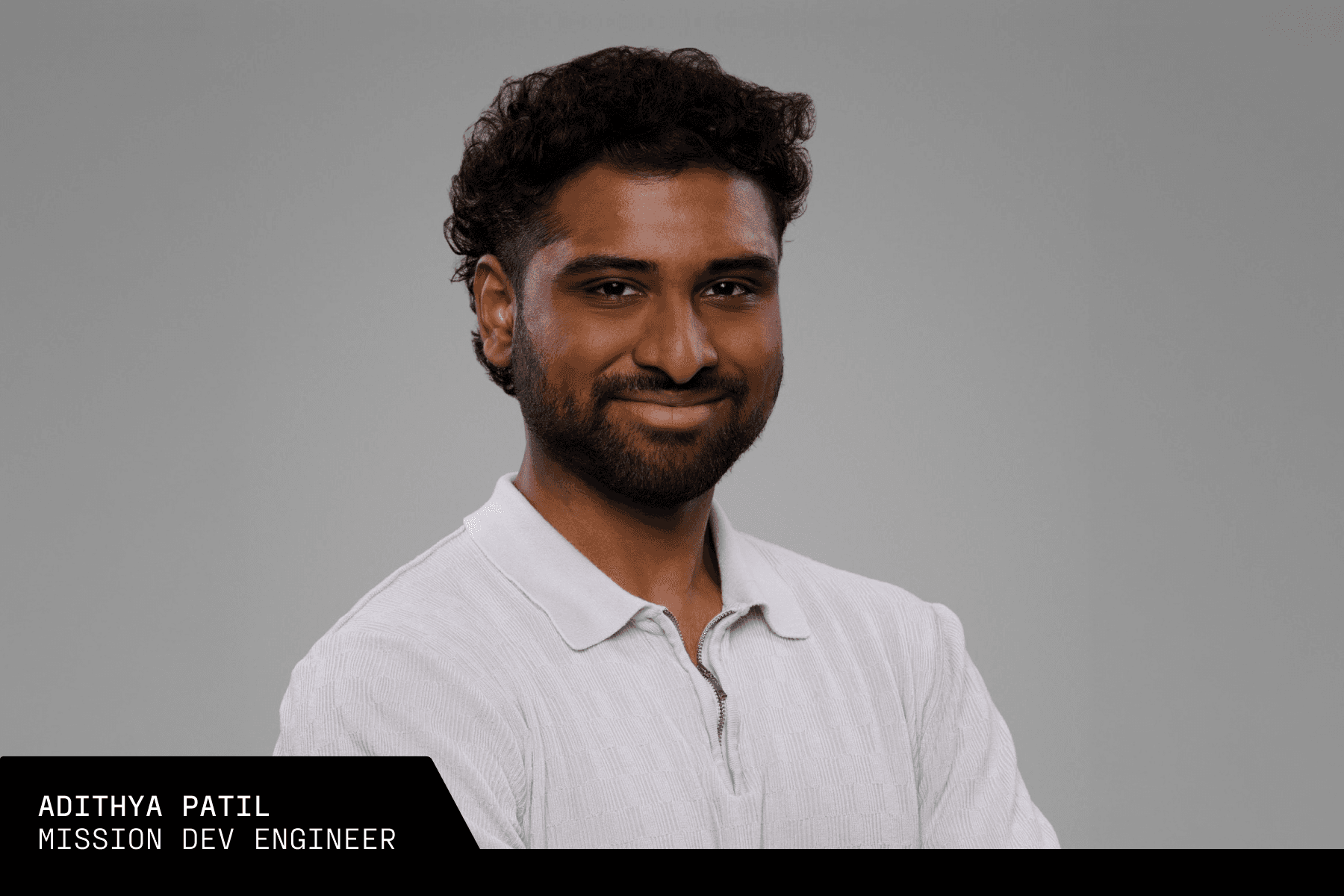
This is the latest in our New Grad Stories series, where early career Nomineers share what it’s like to build alongside the engineers putting real hardware in the air, on the road, and into orbit.
If you want to work on AI that engineers building the most ambitious machines depend on , this is what that job looks like.
Wanting to move fast
Adithya went to Georgia Tech to study his lifelong passion, aerospace engineering. Freshman year, he thought that dream was ignited when he joined the club rocket team. He quickly learned that one loop of testing, redesigning, and testing again could take months. A lot of those hours went into staring at graphs, trying to figure out where a test fell short.
"I left aerospace engineering because I thought hardware moved too slowly," he says. He switched to computer science so he could turn things around faster. The switch came at a personal cost. He figured he was walking away from his dream to work on rockets and spacecraft, the things that drew him to engineering in the first place.
While he was at his first job out of college, he started interviewing for a Mission Dev role at Nominal. He was drawn to the idea that software can speed up the exact hardware test loop that had steered him away from aerospace. The people he met on the team kept telling stories from customer sites that he had experienced first hand on the Georgia Tech rocket team.
"I wanted to be in those rooms again," he says. "Nominal reignited my passion for aerospace engineering by being able to solve physical problems with my software skills."
No internet, no shortcuts
A few months in, Adithya was helping deliver Nominal's first classified deployment, getting its software running in a top-secret space.
"A classified network means no internet, locked-down machines, and every piece of software carried in by hand, so most of the usual ways of debugging disappear," he says.
The first trip didn't get them all the way there. A server kept rebooting itself under heavy disk load. Time syncing broke across the cluster. Security controls on the machines clashed with Nominal's software in ways you'd never see in the cloud.
"Each time, we came home, fixed what broke, and went back."
The last hurdle was monitoring. When Adithya opened Grafana on a fresh test stack headed to a customer, he found hundreds of alerts firing on a perfectly healthy system. Ship that, and the customer learns to ignore every alert, including the one that matter. He and a teammate traced each one and set a goal of zero alerts two days before the server shipped.
The install wrapped a few weeks ago. Every fix from those months of troubleshooting are now part of Nominal's standard airgapped install, so the next classified deployment starts from a working path.
Having room to make mistakes
Work like that runs on trust, and Adithya says that took some getting used to.
"People here trust each other more than anywhere I've worked. That was overwhelming at first, because I didn't feel like the right person to own certain problems."
His team leads gave him room to grow into it. When he was writing up how Nominal should ship releases to airgapped customers, they connected him with people who had lived through managing on-prem environments and let him gather those insights himself. When they read his draft, they pointed out a group he'd missed, customers who host Nominal themselves but are still connected to the internet.
"They let me make smaller mistakes, help me understand what went wrong so I spot it faster next time, and are always ready to step in without taking over."
What students can learn right now
Ask Adithya what students should be studying and the first thing he says might surprise you.
When he chases a bug now, most of the job is pointing AI tools at the right place and checking their assumptions. The models can read the implementation details themselves. Most of his time goes into thinking through designs at a high level and making calls from his own experience, which AI still isn't great at. That skill matters at Nominal because so much of what the team builds has to scale and last for years.
"Studying how existing systems work is the fastest way to build that," he says. For him, that was a Distributed Systems class at Georgia Tech, a full semester of taking apart production distributed systems. He still uses what he learned every time he designs something.
Back to the graphs
Adithya still thinks about those hours on the university rocket team, squinting at plots of data. A lot of Nominal's customers still debug that way, and Nominal has made that information easier to work through. The next step is bringing what AI has done for software debugging over to hardware.
"With Analyst, we're working toward the same thing for hardware: engineers spinning off agents that dig through a test with instant recall of tons of past data," he says. "Freshman-year me would have loved that."
Interested in joining Nominal? We have new grad roles open: nominal.io/careers (opens in new tab)