Wisk + Nominal: A Certification-Grade Test Record
Wisk moved from five-hour post-flight analysis loops and laptop-bound data to a shared, certification-grade system of record for battery, flight test, and propulsion teams.
Mission brief
- Founded
- 2019
- Headquarters
- Mountain View, California
- Offices
- Fremont, CA; Hollister, CA; Montreal, Canada
- Mission
- Deliver safe everyday flight for everyone.
- Core technology
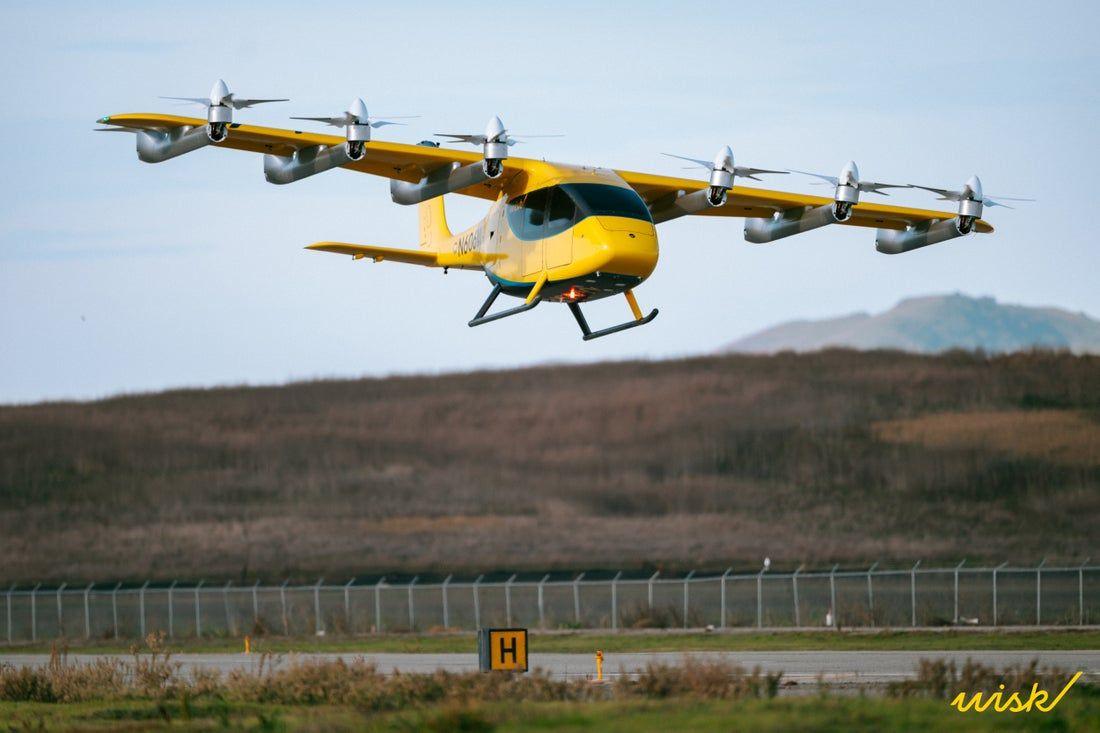
- A 4-seat electric vertical takeoff and landing (eVTOL) air taxi designed for fully autonomous flight.
- Focus
- Revolutionize urban mobility with cost-efficient, medium-distance air travel.
Wisk needed to move fast in one of the hardest-to-certify categories of hardware there is: unmanned aircraft.
The challenge: high-tempo testing, fragmented data
Every critical system on Wisk's aircraft has to be rigorously tested and validated, and because electric aviation is still a nascent category, Wisk carries a high burden of proof on systems that already have decades of precedent in conventional aircraft.
Wisk runs high-tempo vehicle and subsystem test campaigns across multiple teams and sites simultaneously. As data volume grew, three problems compounded:
- Turnaround. Post-flight uploads and analysis took five to six hours before engineers could start investigating an issue. When a finding blocks the next test, hours can turn into days.
- Validation. Battery subsystem testing required coordinated command and control, live fault monitoring, and comparison across six packs at once.
- Tooling gap. Prior workflows depended on command-line snapshots, Jupyter notebooks, third-party LabVIEW apps, spreadsheets, and bespoke tooling that varied by team. Processed data lived on individual engineers' laptops, so shared context disappeared the moment that analysis began.
Nominal transformed our testing workflow by replacing tedious manual data review with automated workbooks generated in minutes. Our team is now free to focus on what matters most: integration and higher-level testing.
Nominal in action
Wisk deployed Nominal to unify battery validation and flight test analysis, moving teams from data capture to shared understanding in minutes.
1. From engineer-in-the-loop to technician-run
Nominal joined the Wisk team in Utah for a critical campaign: validating emergency disconnect of the battery in the event of a short circuit.
Using Nominal, the team built a live telemetry dashboard that could open and close battery contactors, assess faults, and monitor cell voltages, currents, and temperatures in real time.
Data was streamed into Nominal, where any Wisk engineer could watch it. That source of truth gave the team in California and the team in Utah the same picture, monitoring live data, collaborating, and making real-time calls during the test. Debugging moved from hours or days to minutes. Nominal's data warehouse ran comparisons against Wisk's historical test data as the test ran, so engineers could tell immediately whether a behavior was anomalous and flag a potential failure before it cost them hardware.
The operational shift matters as much as the speed. Data collection on a battery test went from over five minutes of engineer-driven work to instantaneous. Across test execution and analysis together, battery-test engineers reclaimed roughly 60% of their time. Enough of the work became repeatable that technicians could run tests independently, instead of an engineer being required in the loop for every cycle. Test throughput stopped being gated by engineer availability.
2. From one team's tool to the test org's system of record
Battery validation was the entry point. Once flight test data landed in the same platform, the pattern repeated across Wisk's engineering organization.
Full-flight telemetry now becomes available within minutes of landing, so post-flight review and issue investigation start immediately instead of five to six hours later. Cloud-based analysis workbooks let engineers investigate across team boundaries. Flight test data sits next to simulation output and propulsion analysis. And templates make the analysis reusable rather than having to be rebuilt every test.
Adoption spread from a single team's tool to the majority of Wisk's engineering test organization, now spanning Flight Test & Ops, Iron Bird, Energy Storage & Power Systems, and Propulsion, and covering full-flight telemetry, hardware-in-the-loop, subsystem, and component validation. The reason is simple: engineers went where the data and the context already were.
We found behavior that occurred for milliseconds in hours-long tests that we never would have found using traditional data review methods.
3. Certification-grade hardware needs a certification-grade system of record
Wisk's trajectory isn't specific to eVTOL. Any team building mission-critical, safety-regulated, or autonomous hardware hits the same wall. Test data volume explodes, and the bottleneck moves from collecting data to making decisions with it.
Once collection is solved, the hard questions are different ones. Is this reading in-family or out-of-family? What did the same component do six months and four builds ago? Who ran this test, on what configuration, and can we show that to a regulator two years from now? Those questions are answered by a system of record with data provenance and a complete historical archive behind it.
That's where Nominal's value compounds. A single workflow speedup is worth a few hours. A shared source of truth that distributed engineering teams collaborate around changes what the organization is capable of proving.
Results
- Analysis time: 5–6 hours post-flight → near real-time
- Data ingest: manual uploads to file storage → 10x faster, with options for automatic ingest
- Battery test data collection: 5+ minutes of engineer time → instantaneous, enabling technician-run tests
- Engineering time reclaimed: battery-test engineers saved ~60% of time on test execution and analysis
- Platform adoption: each team on its own tech stack → one unified platform across Wisk's integrated product teams
- Edge operations: limited capability at test ranges → UI-driven, hardware-connected test applications
Nominal was a game-changer for our battery testing. We now solve critical problems in minutes instead of days by instantly syncing telemetry and video.
Looking ahead
Wisk is flying, but the harder work is ahead: certifying an aircraft for fully autonomous passenger operations. Nominal is planned to be deployed and operating in Wisk's own GCP environment, with data migration and production-readiness work underway to carry the platform from campaign support into permanent program infrastructure.
As the flight test program scales, the data lands in the same place, in the same format, comparable against everything that came before it. That archive is what turns each test into evidence rather than a one-time result. And evidence is what certification runs on.
Ready to deploy wherever you test.